
Introduction
Decorating a rented wall comes with a pretty specific constraint: nothing permanent, nothing that puts a security deposit at risk, and ideally nothing that leaves a trace once it comes down. That used to mean a fairly bare-looking apartment, resigned to a few posters and empty corners. It doesn’t anymore.
Between better adhesive hook technology, peel-and-stick wallpaper that actually peels and sticks the way it claims to, and a much wider range of leaning and freestanding display options, renter-friendly wall decor has quietly become genuinely versatile.
I’ve written a fair amount about home styling over the years, and one thing that comes up again and again is renters assuming their options stop at a few framed prints on Command strips. That’s just not true anymore.
There are dozens of approaches — some fully temporary, some semi-permanent but completely reversible — that can make a rented space feel just as intentional as one someone owns outright. This runs through 31 ideas, grouped by method, so you can match the approach to your lease and your actual walls.
What “Damage-Free” Really Means
Before getting into the list, it’s worth pinning down what actually counts as damage-free. Most lease agreements draw a line between damage that needs repair — holes, paint chips, torn drywall — and normal wear. The safest options tend to fall into three buckets.
Adhesive-based. Removable hooks, strips, and tapes rated for a specific weight, built to come off cleanly when removed the right way — usually pulling straight down, not outward, which trips people up more often than you’d expect.
Non-adhesive, non-drilling. Leaning art, freestanding shelves, tension rods, anything furniture-based that touches the wall without actually attaching to it.
Reversible surface treatments. Peel-and-stick wallpaper and decals made specifically for rentals, designed to lift off without pulling paint along with them.
Worth saying clearly: always check your specific lease and paint type first. Textured walls or older paint jobs can behave pretty differently with adhesives compared to smooth, recently painted drywall, and there’s no substitute for testing a small patch before committing to a whole wall.
Adhesive Hook and Strip Ideas
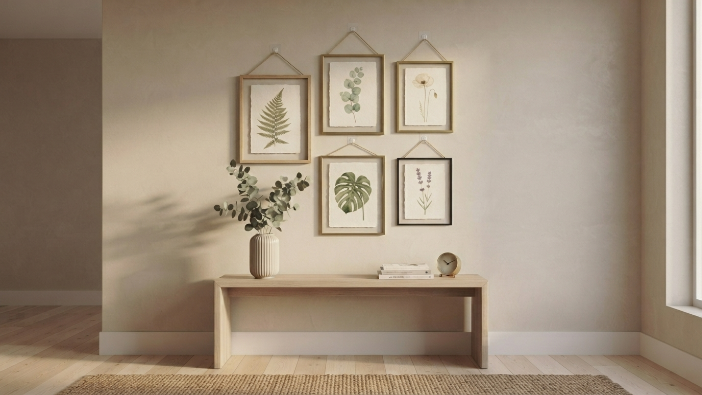
Weight-rated adhesive strips, sized to the actual weight of whatever you’re hanging rather than guessed at — this one detail prevents most failures.
Adhesive picture-hanging hooks for slightly heavier frames, which spread the weight more evenly than strips manage on their own.
Small adhesive hooks for a mini gallery of postcards or photos, clipped in place with binder clips or washi tape. Also read dining room ideas for your interior home decor.
Adhesive-mounted floating shelves, rated for light decorative objects — gives you a display surface without touching a drill.
Adhesive hook and string display for hanging lightweight art on wire, which mimics that gallery-style hanging system without any of the hardware.
Leaning and Freestanding Ideas
A large framed piece leaned against the wall on the floor reads as intentionally styled, not unfinished — this trips people up because it looks almost too simple, but it works.
A leaning ladder shelf for displaying small art, plants, or books along a wall.
A floor mirror leaned into a corner, which adds light and a decorative element without a single point of wall contact.
A tabletop easel for rotating artwork on a console or shelf, easy to swap out whenever the mood changes.
Layered leaning frames, varying sizes, front to back — gives you that curated, gallery-like effect without hanging anything at all.
Removable Wallpaper and Decal Ideas
Peel-and-stick wallpaper on a single accent wall, chosen in a pattern that actually suits the room’s existing palette rather than fighting it.
The same wallpaper inside a bookshelf or cabinet back panel — a much lower-commitment way to test a pattern before going bigger.
Vinyl wall decals for a graphic, temporary statement in a bedroom or entryway. Also read decor for empty spaces.
Removable wallpaper as a headboard substitute, applied in a rectangle behind the bed to fake a built-in headboard.
Textured peel-and-stick panels — faux shiplap or brick — for adding architectural interest without touching the actual architecture.
Tension Rod and No-Drill Solutions
A tension rod mounted between two walls, for hanging a lightweight tapestry or fabric panel.
A tension rod inside a window or alcove, used to display a curtain purely as a decorative backdrop rather than a functional window treatment.
A tension rod bookshelf ladder for narrow gaps, which doubles as storage and wall styling at the same time.
A tension-mounted curtain rod set up behind furniture, creating a soft fabric backdrop behind a bed or sofa.
Textile-Based Decor Ideas
A large tapestry hung from adhesive hooks adds color and texture across a big wall while barely registering any weight.
A quilt or woven textile draped over a wall-mounted dowel, held up with adhesive hooks rather than nails.
Fabric-wrapped canvas panels, light enough for adhesive strips and easy to swap out seasonally if you like changing things up.
A macramé wall hanging, for texture and dimension without needing any heavy-duty mount.
Gallery Wall Ideas for Renters
A grid gallery wall using uniform adhesive strips, measured and marked out with painter’s tape before you commit to anything permanent-feeling.
A salon-style leaning gallery on a console table or mantel, which sidesteps wall mounting entirely.
A gallery wall built on a large corkboard or pegboard, itself mounted with adhesive strips — lets you rearrange the art underneath without needing fresh adhesive every time.
A magnetic wall panel, mounted with adhesive strips, so you can swap printed art in and out with small magnets whenever you want.
A Few More Worth Trying
Command hook-mounted string lights, shaped around art or photos for a soft evening glow.
A large woven basket display, hung with adhesive hooks, adding texture above a headboard or in an entryway.
A collection of small framed botanical prints, arranged asymmetrically with adhesive strips.
A rotating seasonal display, using one adhesive hook and interchangeable art on a simple wire hanger.
Case Study: A Studio Apartment Styled Entirely Without Nails
While researching apartment styling for renters, I came across a studio apartment where building management had drawn a hard line: absolutely no nail holes, not even small ones, or a chunk of the deposit was gone.
The tenant worked entirely with adhesive strips, leaning furniture, and one large piece of peel-and-stick wallpaper behind the bed. The wallpaper went up first — a soft botanical print that anchored the sleeping area and honestly did most of the visual work on its own.
Around it, weight-rated adhesive hooks held two framed prints and a woven wall basket, and the living area got finished off with a large leaning mirror and a gallery of postcards on a corkboard, itself mounted with adhesive strips.
At move-out, everything came down cleanly — including the wallpaper, which had been specifically rated as removable from the start. The full deposit came back. The lesson worth pulling out of this one: a single well-chosen anchor piece, the wallpaper in this case, can carry an entire room, which lets everything else stay simple and low-commitment.
Common Mistakes

Guessing at adhesive weight limits. Always check the rated weight of a hook or strip against the real weight of the piece, frame and glass included — this is where most failures happen.
Removing hooks the wrong way. Pulling straight down, not outward, is what lets most removable strips release cleanly. Pulling out or sideways is basically asking for trouble.
Testing wallpaper on the wrong spot. Textured, freshly painted, or older paint can all react differently — always test a small patch somewhere hidden before committing to a full wall.
Overloading a single hook. Spread weight across several rated hooks instead of stacking multiple items on one, even if it seems like overkill.
Skipping the lease review. Some buildings restrict wallpaper or adhesives even when the product itself is marketed as removable, so it’s worth an actual read-through before committing to anything.
A Quick Checklist
- Lease reviewed for wall decor restrictions
- Adhesive products weight-tested against the actual item’s weight
- Wallpaper or decal tested on a small hidden patch first
- Placement measured and marked with painter’s tape before committing
- Removal method (straight-down pull) understood before hanging anything
- Heavier items distributed across multiple hooks, or leaned instead
Final Thoughts
Renter-friendly wall decor has moved well past a handful of Command-strip posters at this point. Between adhesive systems, leaning displays, removable wallpaper, and textile-based options, it’s entirely possible to build a fully styled, layered-feeling home without ever putting a nail in the wall.
Start with one anchor piece — a wallpaper accent, a large leaning mirror, a tapestry — and build the rest of the room around it, checking weight ratings and lease terms before anything actually goes up.
FAQs
What’s the best renter-friendly way to hang heavy art?
Weight-rated adhesive hooks, sized specifically to the frame’s total weight, tend to work best — or lean the piece against the wall and sidestep the weight limit entirely.
Does peel-and-stick wallpaper damage walls?
Most reputable removable brands are built to lift off cleanly, but it’s still worth testing a small patch first, especially on older or textured paint.
How do I remove adhesive strips without taking paint with them?
Pull the tab straight down, parallel to the wall, rather than pulling outward — that’s what releases the adhesive grip cleanly in most cases.
Can I build a gallery wall without any nails?
Yes — weight-rated adhesive strips, a mounted corkboard, or a leaning salon-style display on furniture all work well here.
What’s a good headboard alternative for renters?
A rectangle of removable wallpaper or a hung tapestry behind the bed fakes a headboard convincingly, without touching the wall structurally at all.
How much weight can adhesive hooks actually hold?
Depends heavily on the product — anywhere from a few ounces up to around 15–20 pounds for heavy-duty rated strips. Always check the packaging for the exact rating rather than assuming.
Are tension rods worth it for wall decor?
Yes — they work well for hanging lightweight tapestries, curtains, or fabric panels with zero wall contact whatsoever.
Will I actually get my full deposit back with removable decor?
In most cases, yes, as long as everything’s rated as removable and taken down correctly. Still worth confirming your specific lease, since policies vary quite a bit building to building.